Scan, Copy and eDiscovery McKinney TX Services for Texas Legal Teams
Managing eDiscovery McKinney TX projects with electronically stored information (ESI) adds pressure during litigation. Legal teams work against strict deadlines while sorting through massive data volumes. Discovery requests grow. File formats change. Review schedules become compressed.
Complete Legal delivers organized eDiscovery support for litigation teams working under deadline pressure. We serve law firms, paralegals, and litigation support teams across Dallas–Fort Worth and throughout Texas. Our focus is direct: communicate clearly, execute reliably, and provide deliverables that are easy to work with when time is limited.
From the beginning of the request to final delivery, we make the workflow easier to manage, faster to complete, and more organized. Whether you need document scanning, OCR conversion, or comprehensive Electronically Stored Information (ESI) support, Complete Legal coordinates every step to reduce manual work and prevent surprises near deadline.
Understanding the Litigation Value of eDiscovery McKinney TX

eDiscovery McKinney TX changes the way legal teams organize, review, and prepare case materials. It includes the identification, collection, and production of electronically stored information for legal matters. That information may be found in email platforms, document storage systems, collaboration tools, and many other data sources across an organization.
Scattered data sources create practical challenges for legal teams. They must search across those locations, preserve content under litigation holds, evaluate documents for relevance and privilege, and prepare productions that opposing counsel can access without confusion.
Traditional Discovery Challenges
- Hand-reviewing documents creates heavy time demands
- Paper-based processes create bottlenecks
- Unclear file versions can lead to mistakes in discovery
- Location-based storage can restrict document availability
- Geographic separation slows shared review work
Modern eDiscovery Advantages
- Large-scale search across massive data sets
- Centralized storage improves access and document structure
- Automated document handling reduces avoidable review errors
- Cloud access allows teams to collaborate from different locations
- Advanced filters help reviewers move through documents faster
The move toward electronic materials improves search and organization while introducing technical demands. Legal teams can filter documents using dates, senders, keywords, or content types, then organize them into review sets. Conversation threading helps show how related messages connect.
Technical complexity grows as data sources and file types increase. Metadata becomes essential, privilege logs must be prepared carefully, and chain of custody records need to be complete. Teams need dependable partners who can manage the technical process without losing sight of legal requirements.
A Start-to-Finish Look at the e-Discovery Process
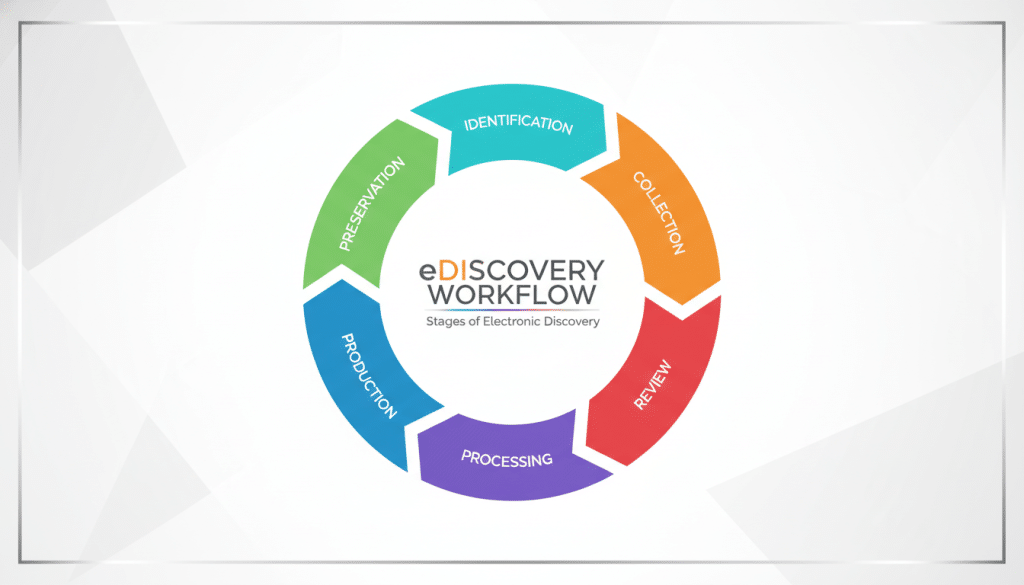
eDiscovery McKinney TX follows a structured workflow. Each phase builds on the previous step. Understanding this process helps legal teams plan resources and manage deadlines effectively.
The Identification and Preservation Stage
The process begins once litigation is reasonably expected. Legal teams need to determine which systems, custodians, and data sources may contain relevant content. Legal holds are then issued to keep that information preserved in its current condition and prevent deletion or changes to possible evidence.
How Collected Documents Become Review-Ready
Following preservation, legal teams collect documents from the sources most likely to contain relevant content. Search queries can combine keywords, date ranges, custodians, and sender information. This approach helps gather what matters while limiting unnecessary collection.
Once documents are collected, processing prepares them for review. Systems pull text from many formats, flag duplicate files, and preserve metadata tied to when documents were created, changed, shared, or stored.
Need Help Managing eDiscovery for Your Case?
Complete Legal manages document processing and ESI preparation so your legal team can stay focused on case strategy. We provide organized, review-ready materials within the timelines your matter requires.
Review and Analysis
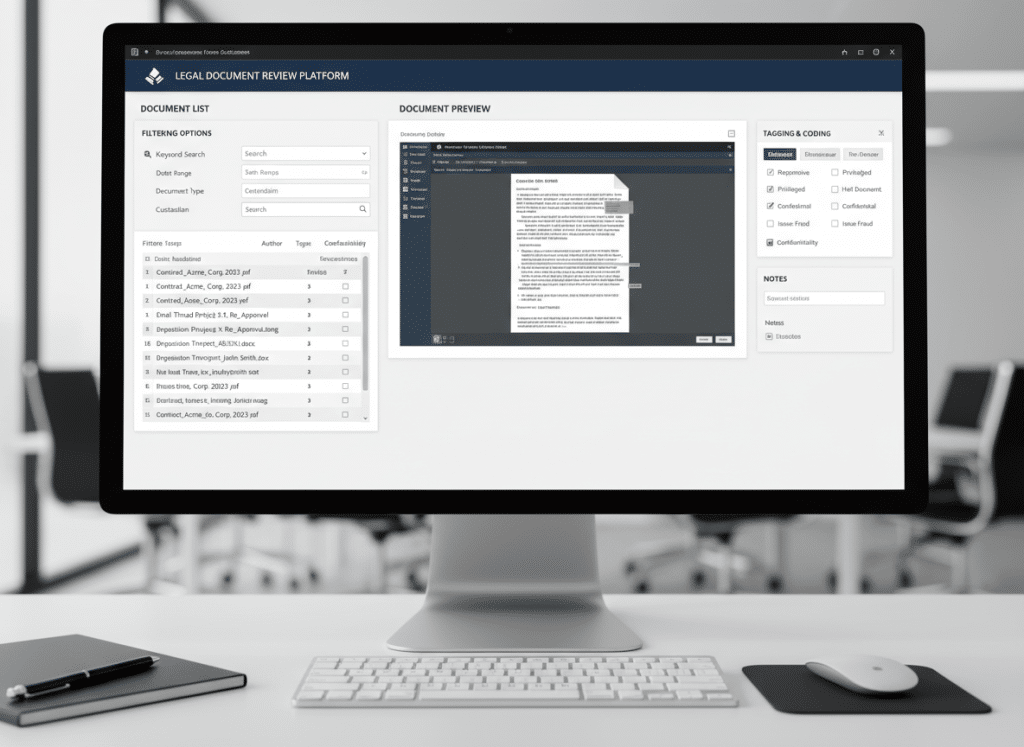
Review is often the most time-consuming and resource-heavy stage of eDiscovery McKinney TX. Legal teams evaluate documents for relevance, separate privileged materials from production sets, and apply tags based on issues, custodians, or categories.
Review sets organize documents logically. Users can filter by metadata, search within documents, and track review progress. Conversation threading groups related email chains together. This reduces the time needed to understand context.
Analytics can guide review teams toward the materials most likely to matter. Similar document grouping shows repeated patterns, email threading connects related messages, and concept clustering helps surface themes across extensive document collections.
The Production and Delivery Stage
The production stage prepares the documents that will be delivered. Files are arranged according to production requirements, Bates numbering gives each page a unique identifier, and load files include metadata that helps the receiving party import the materials correctly.
Third-party platforms usually need productions prepared in specific ways. Native files remain in their original format, while image productions convert documents to TIFF or PDF and include metadata. The chosen method depends on the matter, production instructions, and opposing counsel agreements.
Organizing Electronically Stored Information for Litigation

Electronically stored information includes the digital data that may matter in a legal case, especially when teams are preparing for eDiscovery McKinney TX. Knowing the main ESI categories and the problems they create helps legal teams build stronger discovery plans.
Structured Data

Structured information usually follows a defined format within databases, spreadsheets, or business systems. Customer files, financial records, and inventory data require search methods that account for field structure and relationships.
Unstructured Data

Free-form digital materials can be harder to organize because they lack predefined fields. Emails, documents, presentations, and text files need full-text search and content review to locate relevant information.
Semi-Structured Data
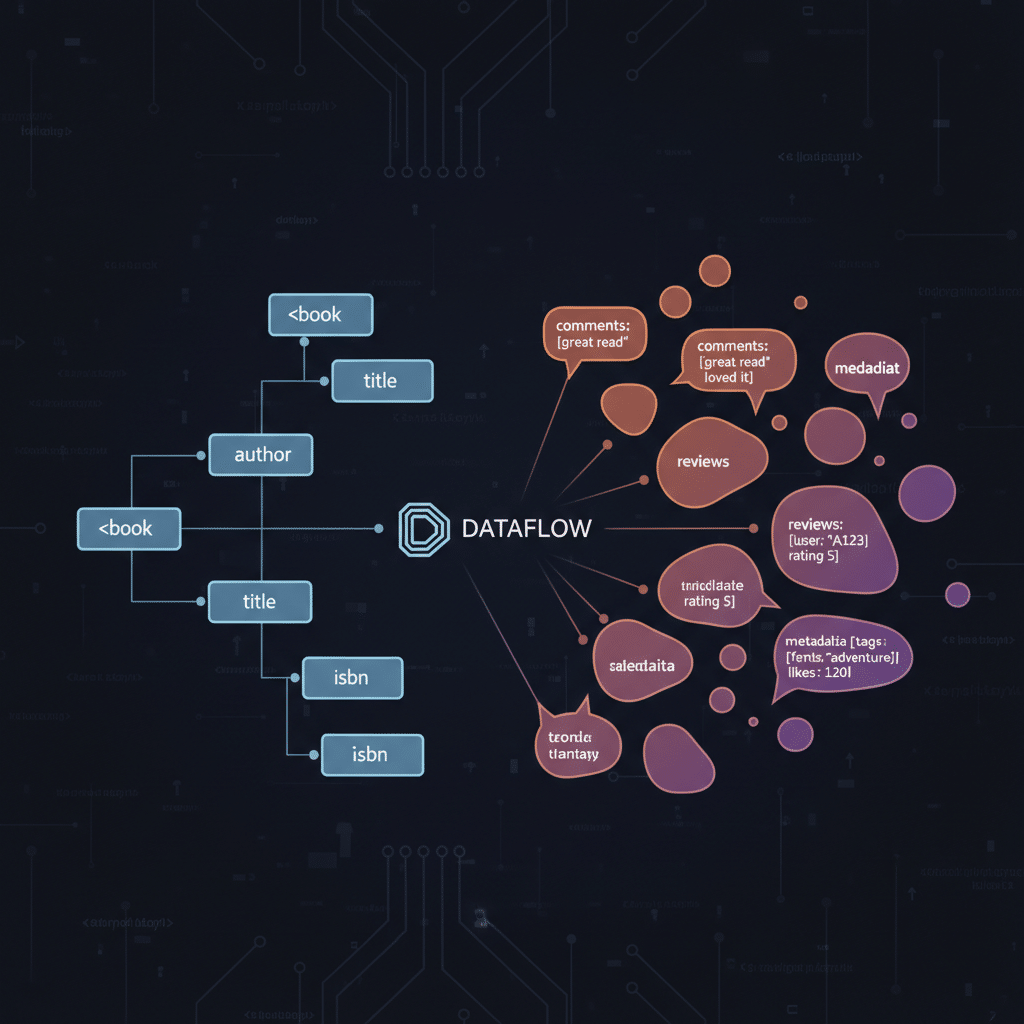
Hybrid data formats have some structure but do not always fit neatly into standard databases. Examples include XML files, log files, and emails that include metadata along with message content.
Key Problems in Managing ESI
High-volume ESI creates serious review challenges. When each custodian may have a large email history, and many custodians are involved, legal teams need tools and support to keep the data manageable.
Different file types make ESI processing more complex. Office files, PDFs, CAD drawings, database exports, and proprietary formats each require specific handling, and some contain embedded content that must be extracted before review.
Preserving metadata is essential, but it requires careful handling. Creation dates, modification times, email headers, and system logs can all provide important context, and poor collection practices may damage or remove that information permanently.
For eDiscovery McKinney TX, Complete Legal brings structure to complicated ESI projects. Our team handles conversion, metadata preservation, and quality checks so your materials arrive organized, usable, and prepared for review.
Effective Content Search and Collection Methods
Legal teams need balanced search strategies for eDiscovery McKinney TX. The goal is to find the right materials without collecting so much data that review becomes inefficient or so little that key evidence is overlooked.
Search Result Management for Discovery Workflows
Search results in eDiscovery McKinney TX must be evaluated before review begins. Teams can use hit counts to understand result volume, previews to inspect sample files, and export options to prepare documents for more detailed analysis.
Refinement helps teams move from broad results to more useful collections. After reviewing initial results, legal teams can change queries, add filters, or narrow criteria based on the content they find. This makes search more accurate over time.
Large result sets benefit from sampling. Reviewing a random sample helps estimate overall relevance rates. This information guides decisions about whether to broaden or narrow search criteria.
Managing Legal Documents with Review Sets and Case Coordination

In eDiscovery McKinney TX, organized documents make review easier and improve collaboration across the legal team. Review sets create structure for large collections, and case management tools help multiple team members stay aligned.
Organizing Documents Into Review Sets
Review sets create order within large discovery collections. Teams can move beyond raw search results and organize documents around case themes, production phases, custodians, or review priorities.
After materials are organized into review sets, processing tools can make them easier to search and understand. Optical character recognition (OCR) pulls text from images, conversation threading connects email chains, and family grouping keeps attachments tied to the documents they came with.
Let Complete Legal Organize Your Discovery Materials
For eDiscovery McKinney TX, Complete Legal creates review-ready document sets with consistent formatting, preserved metadata, and practical organization. Your team gets deliverables that are clean, structured, and easier to manage under pressure.
Case Management for Legal Team Coordination
Multiple reviewers can work more effectively when case management tools keep the process organized. These systems assign materials, show progress, and help teams apply tags in a consistent way.
Role-based access controls limit who can view sensitive materials. Administrators manage case settings. Reviewers access documents assigned to them. Analysts run reports on review progress and document statistics.
Building a Clear Tagging Strategy
Within review sets, tags act as markers that help legal teams sort and analyze documents. They can reflect responsiveness, privilege, relevance, or issue categories, which makes filtering and reporting more reliable.
Objective tags capture factual information. Document dates, custodians, and file types represent objective tags. These often get applied during processing through metadata extraction.
Subjective tags depend on reviewer decisions. Relevance, privilege, and issue coding require legal judgment, so they need careful human review to be applied accurately.
Tag hierarchies organize related concepts. A privilege tag might include subtags for attorney-client privilege, work product, or other privilege types. This structure supports detailed reporting while maintaining high-level filtering capability.
Complete Legal’s Full-Service eDiscovery Support
Complete Legal delivers eDiscovery support designed for legal teams under deadline pressure, including eDiscovery McKinney TX projects that require organized execution. We handle the technical complexity so you can focus on case strategy. Our services span from initial document capture through final production delivery.
Document Scanning and Digital Copy Support
Paper documents still appear in many cases. Converting physical materials to digital format creates searchable, shareable files. Our scanning services handle documents of all sizes and formats.
High-speed scanning helps convert standard legal documents without sacrificing quality. Letter and legal size materials can be delivered in PDF, TIFF, or multi-page formats suitable for review workflows.
Oversize scanning is useful when case materials include maps, plans, blueprints, or engineering drawings. Wide-format and color scanning help maintain detail, scale, and visual information that may matter during review.
Digital deliverables can be prepared to match specific production instructions. We format files based on court orders, opposing counsel agreements, or matter requirements, with logical organization and consistent naming.
Standard Scanning
- Letter and legal size documents
- Single and double-sided capture
- Black and white or grayscale output
- PDF or TIFF format delivery
Oversize & Wide Format
- Blueprints and engineering drawings
- Maps and site plans
- Posters and presentation boards
- Preservation of scale and detail
Color Document Processing
- Photographs and images
- Highlighted or annotated documents
- Color-coded materials
- Charts and diagrams
Searchable Text and Document Conversion
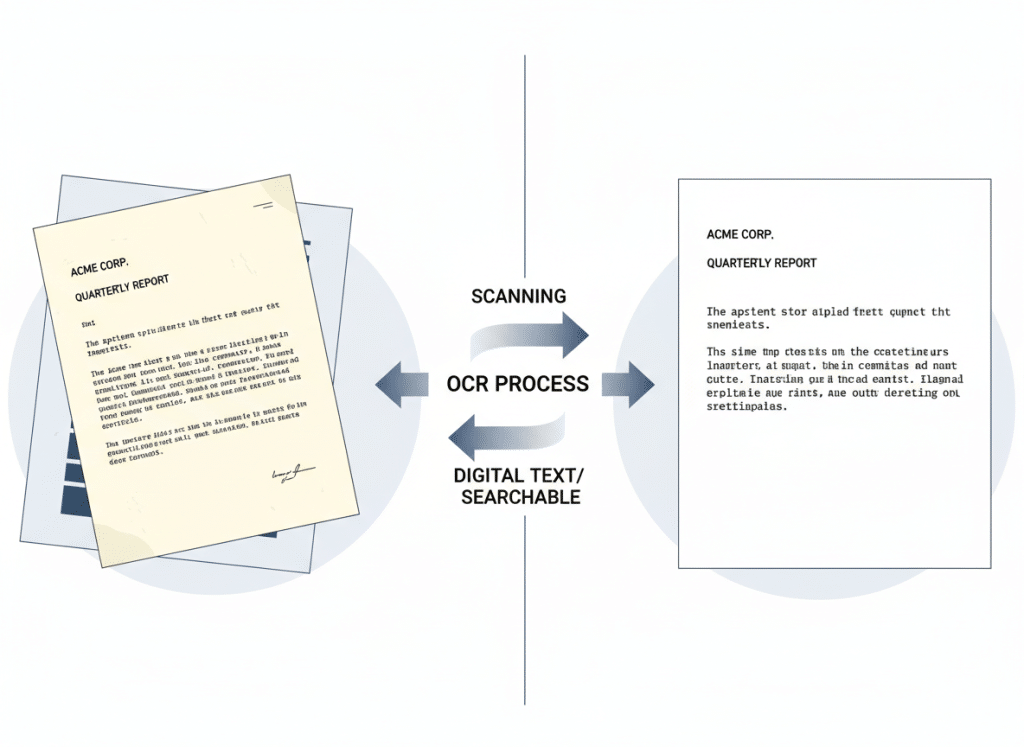
Optical character recognition transforms scanned images into searchable text. This process enables full-text search within documents. It also allows text extraction for analysis and reporting.
OCR results depend on document quality, and our process accounts for different conditions. Clean typed pages can convert with strong accuracy, while handwritten notes or lower-quality copies receive appropriate processing to improve text recovery and usability.
Format conversion adapts files to required specifications. Native files convert to image formats with extracted text. Unusual file types get transformed into standard formats that review platforms can handle. Metadata is preserved throughout conversion processes.
eDiscovery Support for Electronically Stored Information
ESI can create technical challenges in eDiscovery McKinney TX, especially when files come from many sources and formats. We assist with processing, standardization, and quality control to make document preparation easier for your team.
Document preparation starts with understanding production requirements. We clarify specifications before processing begins. This prevents rework and ensures deliverables meet expectations the first time.
Conversion workflows prepare native files for production by changing them into required formats. Metadata is extracted and included in load files, document families remain connected, and numbering follows the agreed pattern.
Each deliverable goes through quality checks before delivery. File counts are compared against the source set, metadata is validated, documents are tested for access, and text search functionality is confirmed.
Partner with McKinney’s Trusted Litigation Support Team
Complete Legal keeps your eDiscovery workflow organized and on schedule. From the first request to final delivery, we provide clear communication and reliable execution. Texas legal teams depend on our deadline-driven approach and secure deliverables.
How Legal Teams Protect Sensitive Data During eDiscovery

eDiscovery McKinney TX requires careful protection of sensitive information from collection through production. Security and compliance measures help legal teams protect confidential materials, preserve client trust, and meet applicable requirements.
Data Security in the eDiscovery Process
Secure handling starts with collection. Forensically sound methods preserve data integrity. Chain of custody documentation tracks materials from original location through final production. Hash values verify that documents remain unchanged during processing.
To protect materials in eDiscovery McKinney TX, teams use encryption during transmission and storage. TLS encryption protects moving files, encryption at rest secures stored data, and access controls limit visibility to approved users.
Access controls should match each user’s role in the discovery workflow. Audit logging tracks who accessed materials and what actions they took, and multi-factor authentication helps protect accounts with administrative permissions.

How Retention Policies Affect eDiscovery
Retention policies determine how long organizations keep data. Legal holds override standard retention rules to preserve materials during litigation. Once holds release, normal retention policies resume.
Compliance requirements vary by industry and jurisdiction. Healthcare organizations follow HIPAA regulations. Financial institutions comply with SEC and FINRA rules. Government contractors meet NIST standards. eDiscovery processes must respect these varying requirements.
Protecting Privilege and Confidentiality
Privileged materials require special handling. Attorney-client communications and work product enjoy legal protections. These documents must be identified during review and withheld from production.
Privilege logs help explain which documents were withheld and why, without exposing the protected substance of those materials. They often include dates, authors, recipients, and the basis for privilege, which makes careful review essential.
Produced documents may require redactions to protect private or privileged content. Information such as personal identifiers, trade secrets, and protected passages must be obscured permanently so it cannot be exposed later.
Security Best Practice: Complete Legal maintains strict confidentiality protocols throughout the eDiscovery process. We use secure file transfer methods, encrypt stored materials, and limit access to authorized personnel only. Your case materials receive the protection they deserve.
What Makes Complete Legal a Strong Choice for Texas Firms
Complete Legal earned recognition as Texas Best through consistent execution and client-focused service for litigation teams that need eDiscovery McKinney TX support. We understand the pressure legal teams face when deadlines approach. Our approach prioritizes clear communication, reliable follow-through, and deliverables teams can depend on.
Litigation Support for Dallas–Fort Worth and Texas Law Firms
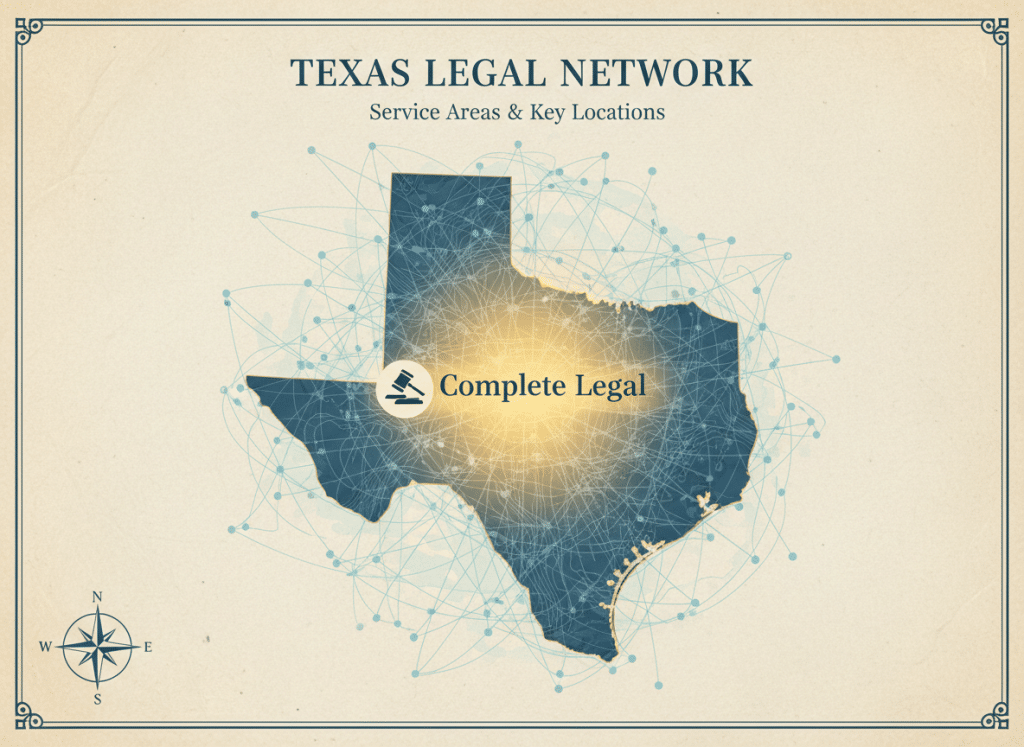
From Dallas–Fort Worth to legal teams across Texas, Complete Legal supports law firms, paralegals, and litigation support professionals. Our Dallas location at 1201 Elm Street is accessible for local clients, while remote support keeps statewide teams connected.
Local presence matters during complex cases. Face-to-face coordination helps clarify requirements. Quick turnaround on rush requests becomes possible with nearby facilities. Dallas teams benefit from our proximity when emergencies arise.
Teams outside the metroplex can still work with Complete Legal through secure remote collaboration. Online access allows clients to review deliverables from any location, digital delivery avoids shipping delays, and cloud-based coordination keeps the project moving.
Integrated Litigation Support Services
Comprehensive litigation support works best when services connect smoothly. Complete Legal offers related support across the case lifecycle, giving legal teams a simpler vendor relationship and more consistent deliverables.
Accurate testimony capture is essential during litigation. Court reporters provide transcripts when schedules are tight, while video depositions give teams a visual record for later review or trial use.
Record retrieval helps legal teams obtain medical records, employment files, and other third-party materials. Complete Legal coordinates with custodians to keep requests moving, while subpoena services support the proper legal process for securing evidence.
Mobile notary services bring authentication to your location. This saves time when documents require notarization during busy litigation phases. Our notaries understand legal document requirements and maintain proper protocols.

Court Reporting
Court reporting support helps preserve testimony clearly and reliably. Certified reporters prepare transcripts, and video depositions provide professional-quality records for remote review and trial presentation.

Record Retrieval & Subpoenas
Complete Legal coordinates with record custodians to help obtain medical records, employment files, and other third-party documents. Subpoena services support proper legal process and help keep document delivery on track.

Mobile Notary & Document Services
Mobile notarization brings authentication support to your location. Complete Legal also provides exhibit boards, binding, mail outs, and specialty printing to help with trial preparation and case management.
How Complete Legal Keeps Projects Clear and Organized
Poor communication can make eDiscovery McKinney TX more stressful than it needs to be. Complete Legal reduces confusion through direct updates, proactive coordination, and clear expectations about what happens next and when.
Coordination begins at the first conversation. Complete Legal confirms requirements before the work starts, responds to questions quickly, and documents specifications so the project does not depend on assumptions.
Regular updates help your team stay aware of project status. Complete Legal notifies you when milestones are completed and communicates quickly if a delay may affect timing, giving you time to adjust before the deadline is at risk.
When deliverables are ready, your team receives confirmation and access information. Clear instructions help reviewers get started, and Complete Legal remains available for support if questions arise.
Ready to streamline your litigation support?
Selecting the Right eDiscovery Partner for Your Firm
Your choice of partner matters when managing eDiscovery McKinney TX for a legal matter. The right provider can simplify the process, lower stress, and help your team work more efficiently from intake through delivery.

Provider Experience and Technical Execution
Technical capability matters because discovery errors can slow review and create more work for the legal team. Providers should know current eDiscovery technology, understand legal requirements, and have experience with many file types and data sources.
Industry experience matters. Providers familiar with legal workflows understand unique requirements. They anticipate issues before they become problems. Their processes reflect lessons learned across numerous cases.
Deadline-Driven Support for Legal Teams
A dependable eDiscovery partner must be able to work within tight legal timelines. Late delivery can push back document review, affect production planning, and create complications your team should not have to manage.
Deadline management is central to how Complete Legal supports legal teams. We understand the pressure created by litigation schedules and prioritize delivery commitments throughout the workflow.
Rush support becomes important when a case changes quickly. Discovery demands may grow, deadlines may shorten, or opposing counsel may require faster turnaround, so having a partner who can accelerate helps protect your strategy.
Quality Control, Accuracy, and Reliable Deliverables
Accuracy matters because even small processing issues can disrupt a case workflow. Missing documents, corrupted files, or unreliable metadata force teams to spend time fixing problems instead of reviewing the materials.
Multiple verification steps help confirm that the document set is complete and usable. Page counts are compared to the source materials, metadata is checked against known values, and sampling helps test accuracy across the collection.
With Complete Legal, quality control is part of the workflow, not an afterthought. We check deliverables carefully so your team can avoid disruptions that waste review time or require costly corrections.
Pro Tip: When evaluating eDiscovery providers, ask for specific examples of how they’ve handled similar cases. Request references from legal teams in your practice area. Understanding their real-world performance provides better insight than marketing materials alone.
Confidentiality Requirements for eDiscovery Partners
Security is essential when a provider handles materials for eDiscovery McKinney TX. Confidential documents need controlled access, careful handling, and strong protocols because breaches can create serious ethical and malpractice concerns.
Do not wait until after delivery to ask about security. Confirm transmission methods, processing storage, user access, backup procedures, and disaster recovery plans before sharing sensitive case materials.
Complete Legal protects client materials through secure file transfer protocols, access-controlled storage, and regular confidentiality training for staff. We handle your case documents with the care sensitive legal work requires.
Transparent Pricing and Overall Value
Pricing should be predictable enough for legal teams to plan responsibly. Transparent cost structures help prevent unexpected expenses and support better communication with clients.
Many litigation support services use pricing that changes with volume. Scanning may cost less per page as quantities grow, while processing may be priced by data size or tier, making early cost review important.
The lowest price is not always the best value. Reliable delivery can prevent costly delays, accurate processing can reduce rework, and clear communication can save the time your team would otherwise spend managing vendors.
Make Your Next eDiscovery Project Easier to Manage
With Complete Legal, every engagement gets clear coordination, proactive communication, and deadline-focused execution. We manage the moving parts so your legal team can spend more time on the case itself.
A Clearer Path Forward for eDiscovery Management
As data volumes rise and technology continues to shift, eDiscovery becomes harder to manage without a strong process. The core principles remain the same: plan clearly, execute reliably, and pay close attention to the details that affect results.
Legal teams benefit from a partner that understands technical workflows and the practical pressure of litigation. Complete Legal brings both perspectives to each project, managing document processing, file conversion, and quality control so your team can stay focused on strategy.
From our Dallas location, Complete Legal supports law firms, paralegals, and litigation support teams in McKinney and throughout Texas. We provide clear communication, deadline-focused execution, and organized workflows from the first request through final delivery.
Complete Legal’s Texas Best recognition points to the standards we bring to litigation support work. We earned it through steady performance, responsive service, and the detailed handling that demanding cases require.
Whether your team needs full eDiscovery support or focused help with scanning, OCR, and ESI preparation, Complete Legal offers the capabilities to support the matter. Our integrated litigation support model reduces vendor complexity and helps keep deliverables consistent.
Start Your Next Discovery Project With Complete Legal
Experience the difference that reliable execution and proactive communication make. Contact Complete Legal today to discuss your eDiscovery needs. We deliver organized, review-ready materials when you need them—no surprises, no last-minute scrambling.
Complete Legal
1201 Elm Street, Suite 2560
Dallas, Texas 75270
Complete Legal offers a broader litigation support model that includes more than eDiscovery. Court reporting, record retrieval, subpoena services, deposition by written questions support, audio/video services, and mobile notary support help legal teams manage more case needs in one place.
Deadline pressure is part of litigation, and Complete Legal structures its work around that fact. Our team understands how legal workflows operate and responds with the urgency and organization your matter requires.
With secure online access, legal teams can review processed materials without waiting on physical delivery. Your team can verify completeness, begin document review, and keep the matter moving as soon as deliverables are ready.
Work with the eDiscovery provider Texas legal teams trust for dependable execution, accurate deliverables, and deadline-focused support. Contact Complete Legal to talk through your next project.
Ready to discuss your eDiscovery project?


